
 CV
CV BlueSky
Publications
Research programmes
Questions that connect the papers
My work spans several publication venues, but it is organized here by the research problems that connect it: cooperation among learning agents, credit and generalization across time and structure, and the wider social and cultural contexts of AI.
Research programme · Ongoing
Reciprocity & Multi-Agent Learning
How can adaptive agents learn to cooperate when benefits are delayed, hidden, costly to produce, or mediated by another learner?
RLC 2026 · Montréal, Canada · August 2026
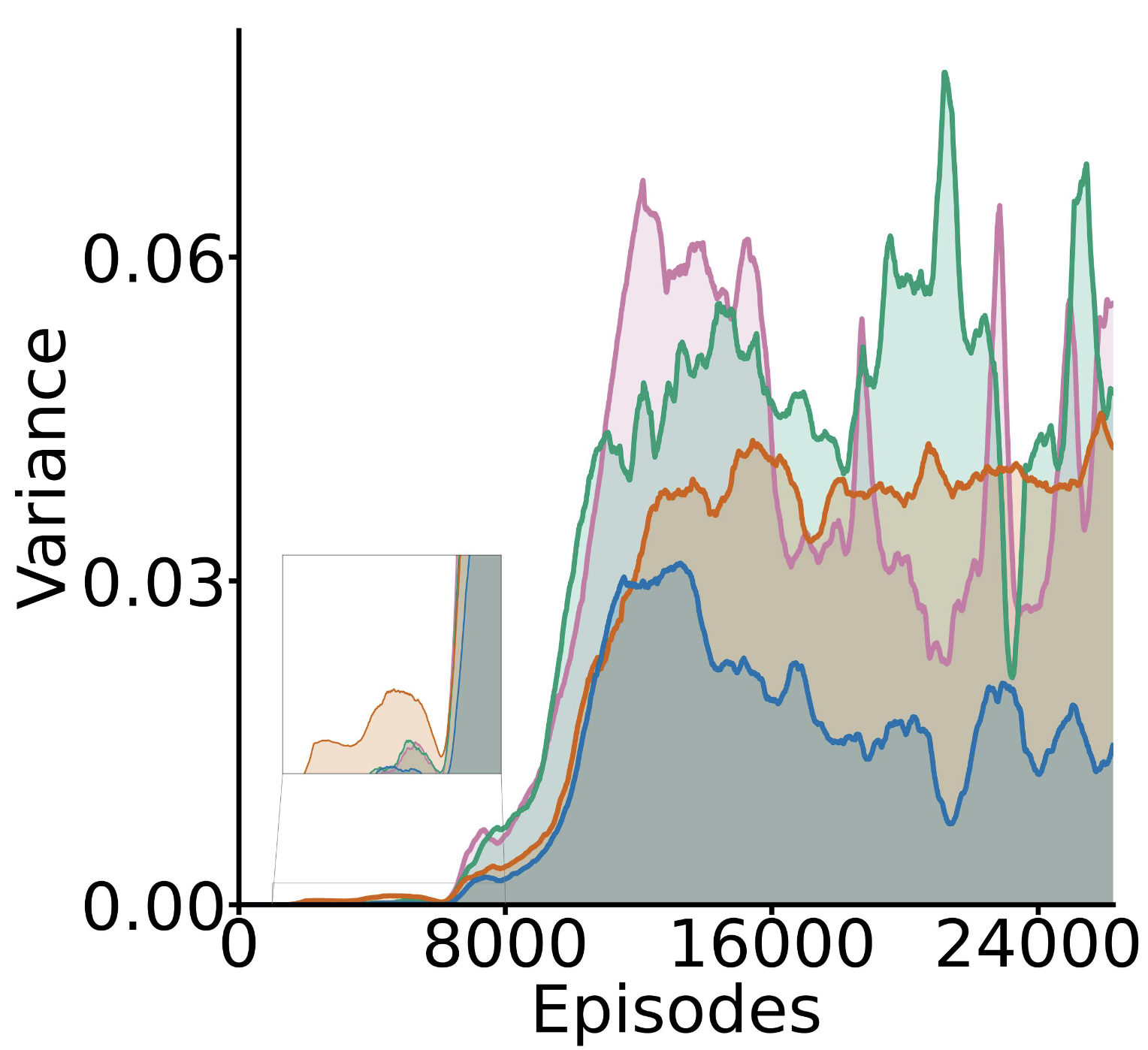
The Challenge of Hidden Gifts in Multi-Agent Reinforcement Learning
- Question
- How can agents learn reciprocal behaviour when helpful actions produce delayed or difficult-to-observe benefits?
- Contribution
- We introduce a shared-key grid-world that makes helpful actions unobservable, show that several state-of-the-art multi-agent reinforcement learning algorithms fail to obtain the collective reward, and derive a learning-aware policy-gradient correction that reduces variance and improves reliable convergence to collective success.
@article{malenfant2026the,
  title={The challenge of hidden gifts in multi-agent reinforcement learning},
  author={Dane Malenfant and Blake Aaron Richards},
  journal={Reinforcement Learning Journal},
  volume={7},
  year={2026}
}
Social Simulation with LLMs @ COLM 2026 · San Francisco, USA · October 2026
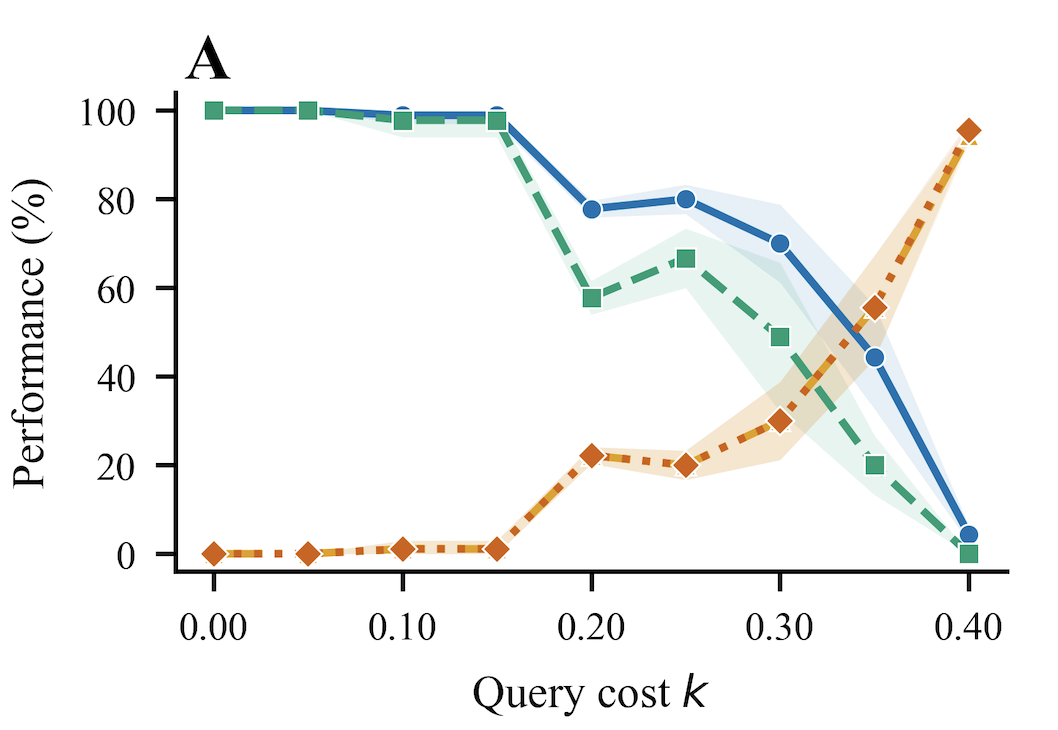
Moral Hazard in Multi-Agent Language Models
- Question
- How do language agents cooperate when gathering useful information is costly, hidden, and primarily benefits another agent?
- Contribution
- I introduce the Dialogue Moral Hazard Game and use it to evaluate 17 language models. The results show that similar team-level success can emerge from different cooperation mechanisms, motivating evaluations that measure information gathering and disclosure rather than aggregate success alone.
@article{malenfant2026moral,
  title={Moral Hazard in Multi-Agent Language Models},
  author={Malenfant, Dane},
  journal={arXiv preprint arXiv:2607.23982},
  year={2026},
  url={https://arxiv.org/abs/2607.23982}
}
arXiv v2 · Revised August 2026 · Presented at World Modeling Workshop 2026
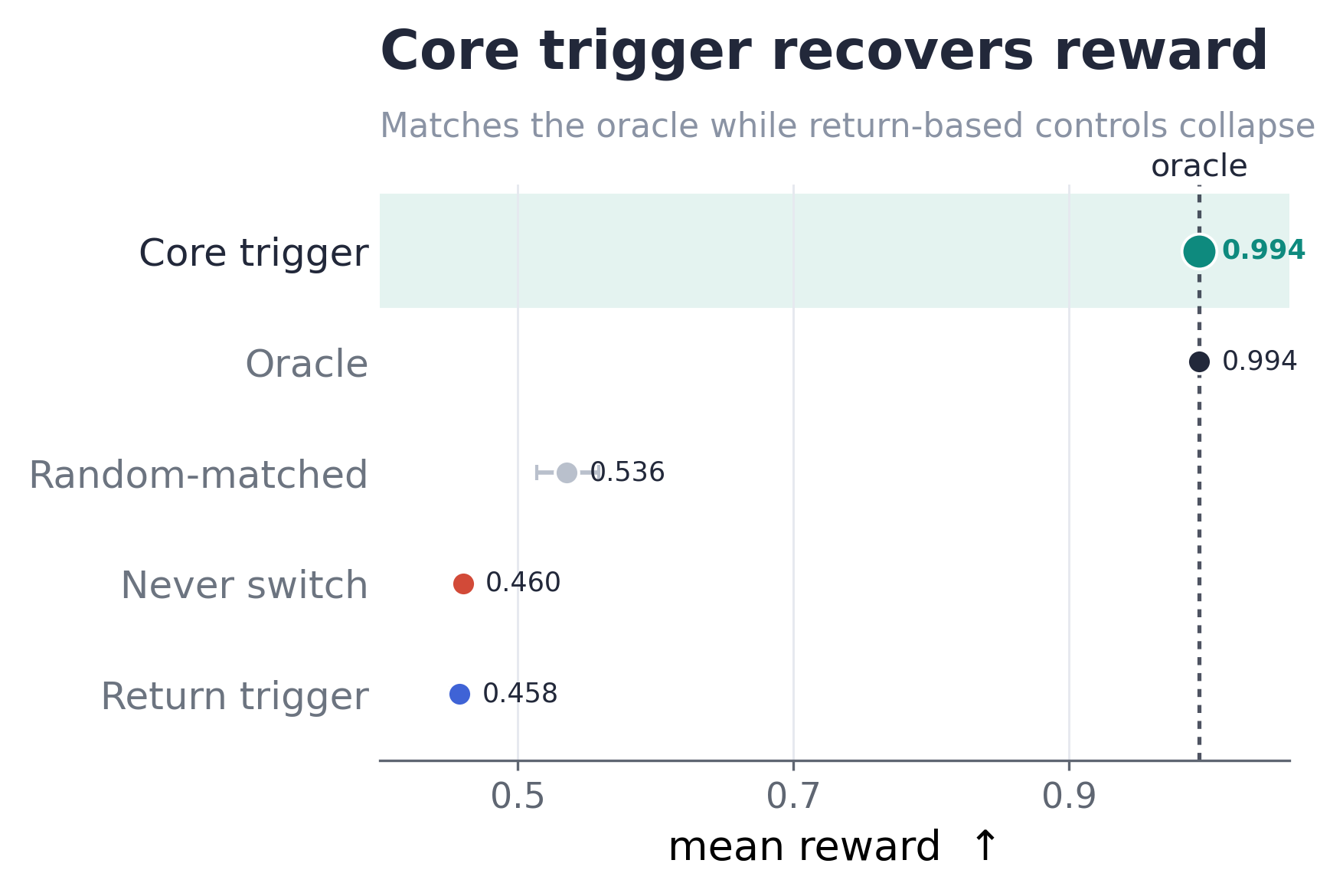
Reinforcing the World's Edge: Continual Learning at the Multi-Agent–World Boundary
- Question
- How long can success-conditioned reusable structure remain valid when peer learning changes the focal agent's induced rewards and dynamics?
- Contribution
- I recast decentralized peer learning as an agent-centric continual-RL problem and define an invariant core of high-coverage abstract patterns in successful trajectories. A worst-case-tight stability theorem yields Ω(1/η) survival and conditional Θ(1/η) first-exit laws; registered 64-stream continual-control and cue-MNIST studies show that core erosion predicts failure and enables near-oracle intervention.
@article{malenfant2026reinforcing,
  title={Reinforcing the World's Edge: Continual Learning at the Multi-Agent--World Boundary},
  author={Malenfant, Dane},
  journal={arXiv preprint arXiv:2603.06813},
  year={2026},
  doi={10.48550/arXiv.2603.06813},
  url={https://arxiv.org/abs/2603.06813}
}
10.48550/arXiv.2603.06813
Research programme · Ongoing
Credit Assignment & Compositional Learning
How can learning systems isolate the decisions and representations that matter, then reuse them across long horizons or unseen combinations?
NeurIPS 2023 · New Orleans, USA · December 2023
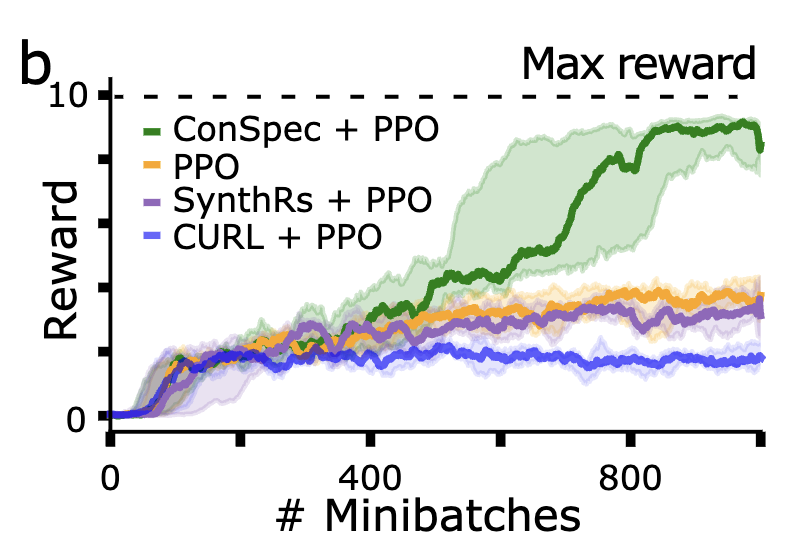
Contrastive Retrospection: honing in on critical steps for rapid learning and generalization in RL
- Question
- How can reinforcement-learning agents identify the few temporally distant decisions that determine eventual success?
- Contribution
- We introduce Contrastive Retrospection (ConSpec), a plug-in method that uses offline contrastive learning to discover interpretable prototypes of critical states and turn them into intrinsic rewards. ConSpec improves learning across diverse tasks and supports out-of-distribution generalization when sensory features change.
@inproceedings{sun2023contrastive,
  title={Contrastive Retrospection: Honing in on Critical Steps for Rapid Learning and Generalization in RL},
  author={Sun, Chen and Yang, Wannan and Jiralerspong, Thomas and Malenfant, Dane and Alsbury-Nealy, Benjamin and Bengio, Yoshua and Richards, Blake Aaron},
  booktitle={Advances in Neural Information Processing Systems},
  volume={36},
  year={2023},
  doi={10.52202/075280-1356},
  url={https://proceedings.neurips.cc/paper_files/paper/2023/hash/6357d6d068622c962391081d296bed69-Abstract-Conference.html}
}
10.52202/075280-1356
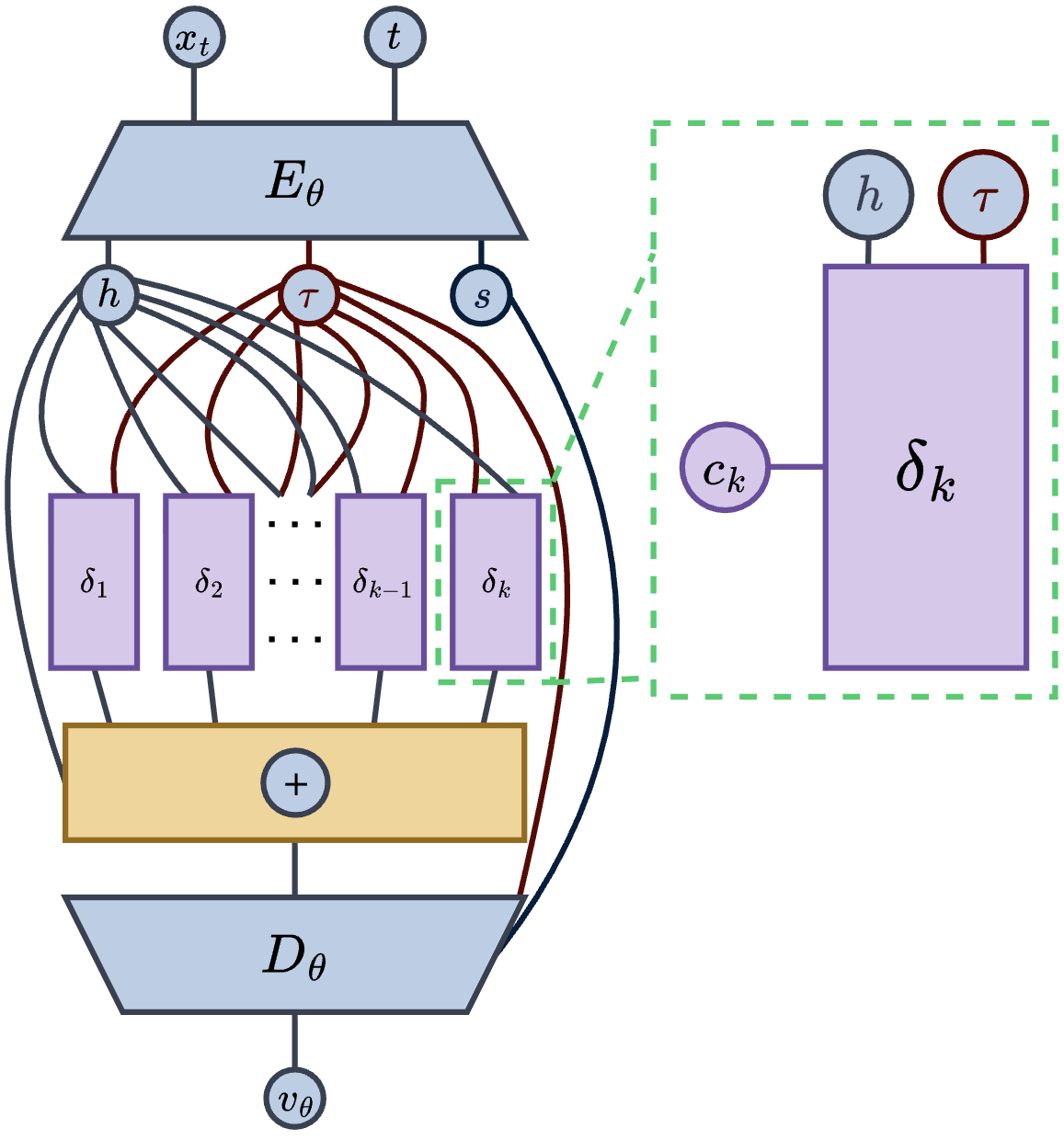
FoGen @ ICML 2026 · Seoul, South Korea · July 2026
Compositional Flow Matching with Factored Velocity Fields
- Question
- How can conditional generative models generalize to novel combinations of factors that were absent from training?
- Contribution
- We propose a factored conditional flow-matching architecture with a shared base velocity and factor-specific heads. It matches or outperforms a monolithic baseline on zero-shot combinations, substantially lowers held-out FID on the hardest Shapes3D splits, and supports adding a new factor without retraining existing components.
@inproceedings{ryoo2026compositional,
  title={Compositional Flow Matching with Factored Velocity Fields},
  author={Ryoo, Avery Hee-Woon and Malenfant, Dane and Perich, Matthew G. and Lajoie, Guillaume},
  booktitle={1st Workshop on Foundation Models (FoGen), ICML},
  year={2026},
  url={https://openreview.net/forum?id=77sT6Xaji7}
}
Interdisciplinary programme
AI in Society & Culture
How do technical systems interact with institutions, public policy, language, and the narratives through which people interpret causality?
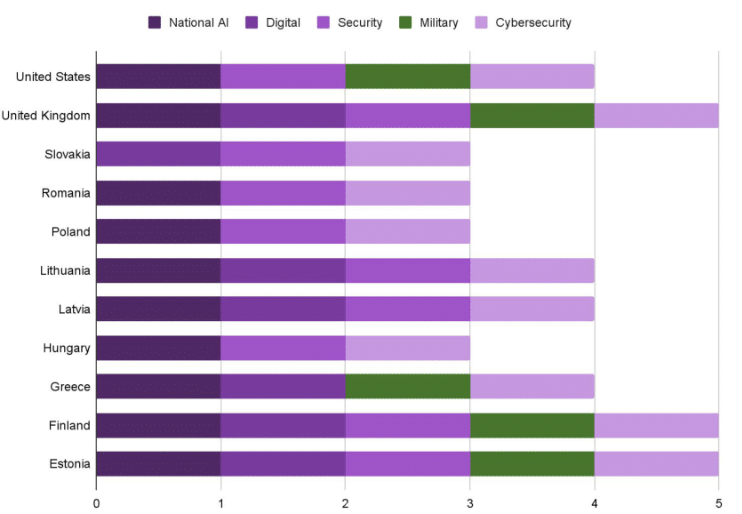
Harms and Risks of AI in the Military 2024 · Montréal, Canada · December 2024
Inconsistencies in Artificial Intelligence Strategy Alignment of NATO Member States
- Question
- How consistently have NATO member states publicly articulated policies for military uses of artificial intelligence?
- Contribution
- We build a comparative dataset from official national strategies and public statements. Although 88% of NATO members had a national AI strategy, only 34% had published military-specific AI policy, revealing a substantial transparency and alignment gap.
@inproceedings{epstein2024inconsistencies,
  title={Inconsistencies in Artificial Intelligence Strategy Alignment of NATO Member States},
  author={Epstein, Itai and Malenfant, Dane and Parker, Sara and Wardrop, Cella},
  booktitle={Harms and Risks of AI in the Military},
  year={2024},
  url={https://openreview.net/forum?id=apB72N0nxF}
}
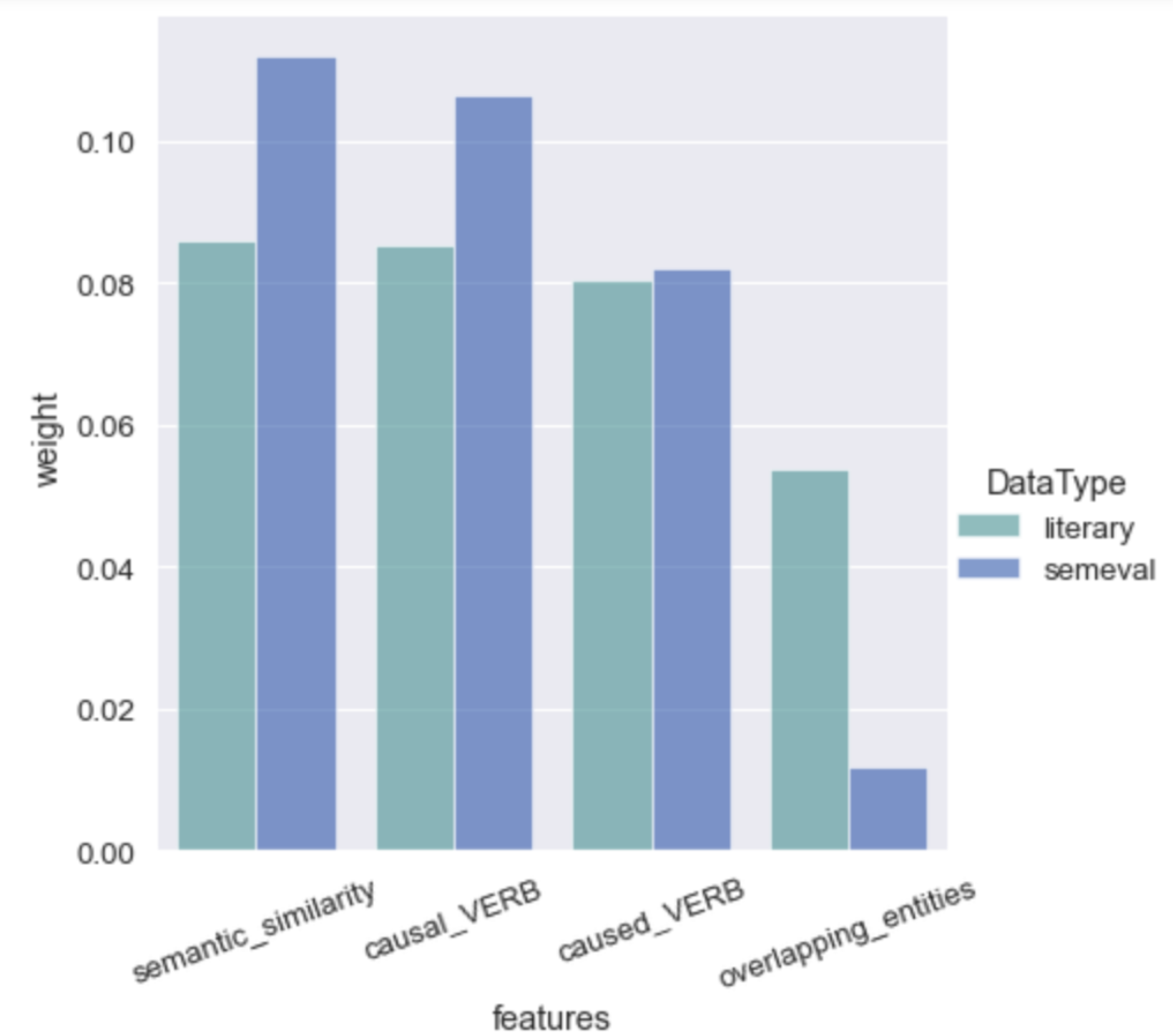
Text2Story @ ECIR 2022 · Stavanger, Norway · April 2022
Causality Mining in Fiction
- Question
- Do causal-relation models developed on standard NLP benchmarks transfer reliably to literary fiction?
- Contribution
- We introduce a labeled dataset containing 548 positive causal event pairs from 141 contemporary literary passages, together with matched negative examples. Comparing feature-based and BERT models against SemEval data reveals linguistic and domain differences that complicate causal-relation extraction from fiction.
@inproceedings{MalenfantP22,
  author={Meehan, Margaret and Malenfant, Dane and Piper, Andrew},
  title={Causality Mining in Fiction},
  booktitle={Proceedings of the 5th Workshop on Narrative Extraction from Texts (Text2Story 2022)},
  pages={25--34},
  year={2022},
  url={https://ceur-ws.org/Vol-3117/paper3.pdf}
}